Being told that you have bone loss can sound like bad news if you are hoping for dental implants. But bone loss does not automatically mean that implants are impossible.
A dental bone graft is a procedure used to increase or rebuild jawbone in areas where there may not be enough bone to support an implant. Some patients need only a small graft. Others may need more extensive bone augmentation before implant placement. In certain cases, grafting and implant placement can happen during the same procedure; in others, the graft needs time to heal first.
For long-term denture wearers and patients who have been missing teeth for many years, this topic is especially important. SmileBridge Costa Rica helps international patients understand the treatment journey, prepare questions, and connect with selected dental implant clinics in Costa Rica for proper clinical evaluation.
What Is a Bone Graft for Dental Implants?
A dental bone graft adds or supports bone in an area of the jaw where bone volume or density may be insufficient for implant treatment.
Cleveland Clinic describes dental bone grafting as a way to increase the volume and density of the jawbone. Cleveland Clinic: Dental Bone Graft.
Mayo Clinic explains that when the jawbone is too thin or too soft, a graft may be needed to create a stronger foundation for a dental implant. Mayo Clinic: Dental Implant Surgery.
Why Does Bone Loss Happen After Teeth Are Missing?
Jawbone is living tissue that responds to function.
Natural tooth roots transmit chewing forces into the surrounding bone. When a tooth is lost, that stimulation changes, and the bone in the area can gradually lose volume.
Bone loss can also be influenced by:
- periodontal disease;
- infection;
- trauma;
- long-term tooth loss;
- anatomy of the jaw and sinus;
- previous extractions;
- other oral and medical factors.
Traditional dentures replace visible teeth but do not replace tooth roots. That is one reason some long-term denture wearers have significant bone changes when they eventually explore implants.
Does Wearing Dentures Mean You Will Need a Bone Graft?
No.
Long-term denture wear can be associated with bone changes, but every patient is different.
Some patients who have worn dentures for many years still have enough bone in useful locations for implant treatment. Others may need grafting, a different implant configuration, or another treatment approach.
The answer comes from clinical examination and imaging — not from the number of years you have worn dentures.
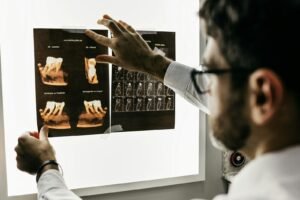
How Does a Dentist Know if You Need a Bone Graft?
Your dental team may use:
- a clinical examination;
- panoramic X-rays;
- cone-beam CT imaging;
- medical and dental history;
- evaluation of the proposed implant location.
Cleveland Clinic notes that cone-beam CT imaging can provide three-dimensional information about bone, nerves, roots, and other structures and can help guide implant planning. Cleveland Clinic: Dental X-rays.
For international patients, imaging can also help a Costa Rican clinic provide a more meaningful preliminary evaluation before travel, although final diagnosis and treatment planning may still require an in-person examination.
What Types of Bone Graft Material Can Be Used?
Bone grafting is not one single technique or material.
Mayo Clinic notes that graft material may come from:
- your own bone from another location;
- human donor bone processed for grafting;
- animal-derived material processed for dental use;
- synthetic bone-substitute materials.
The choice depends on the size and location of the defect, the planned procedure, the clinician’s approach, and patient-specific factors.
A patient should feel comfortable asking:
“What graft material are you recommending, where does it come from, and why are you recommending it for my case?”
What Is Socket Preservation?
Socket preservation is a grafting approach performed at or soon after tooth extraction to help maintain bone in the extraction area.
This can be useful when an implant is planned later but cannot or should not be placed immediately.
Not every extraction requires socket preservation, and it does not guarantee that additional grafting will never be needed. The dental team decides based on the anatomy and future treatment plan.
What Is Ridge Augmentation?
When bone has narrowed or lost volume after tooth loss, the ridge may need to be rebuilt before or during implant treatment.
Ridge augmentation is a broad term for procedures that increase bone volume so the area can better support implants.
The amount of grafting required can range from relatively minor augmentation to more complex reconstruction.
What Is a Sinus Lift?
A sinus lift, or sinus augmentation, may be considered when implants are planned in the back of the upper jaw and there is not enough bone height beneath the maxillary sinus.
The procedure increases bone in that area so implants can potentially be supported.
A sinus lift is not the same as every other dental bone graft. It is specific to the anatomy of the upper posterior jaw.
A sinus lift is a distinct grafting procedure, and patients should ask the treating team why it is being recommended and how it changes the implant timeline.
Can a Bone Graft and Dental Implant Be Done at the Same Time?
Sometimes.
Mayo Clinic explains that minor grafting may be performed at the same time as implant placement in appropriate situations. More substantial grafting may need to heal first before an implant is placed.
The decision depends on:
- how much bone is available;
- where the implant is planned;
- the size of the defect;
- the ability to obtain implant stability;
- the surgical plan;
- the patient’s health and healing factors.
How Long Does a Bone Graft Take to Heal?
Healing time varies considerably.
Mayo Clinic notes that more substantial grafts can require several months for enough new bone to develop before implant placement. Cleveland Clinic similarly notes that when grafting is needed first, a healing period may be required before the implant is placed.
The key point for international patients is that bone grafting can change the travel timeline.
A treatment plan that initially sounds like two trips may require an additional stage if extensive grafting must heal before implants are placed.
Does Bone Grafting Make Dental Implant Treatment Take Longer?
It can.
If the graft must heal before implants are placed, the overall process can be extended by months.
If a minor graft is performed at the same time as implant placement, the timeline may be different.
This is one reason patients should not book flights based only on a generic “All-on-4 in one trip” advertisement.
For a broader timeline, see How Long Does the Dental Implant Process Take?.
Does Bone Grafting Hurt?
Bone grafting is a surgical procedure, so postoperative discomfort, swelling, tenderness, or bruising can occur.
The amount of discomfort depends on the procedure, graft location, extent of surgery, whether extractions or implants are performed at the same time, and individual healing.
Your dental team should explain anesthesia, pain management, postoperative instructions, diet, and warning signs before treatment.
A responsible clinic should not promise that the procedure is completely pain-free.
What Are the Risks of Dental Bone Grafting?
Like other oral surgical procedures, grafting carries risks.
Potential problems can include:
- infection;
- bleeding;
- swelling and discomfort;
- delayed healing;
- loss or failure of graft material;
- injury to nearby structures depending on the location;
- need for additional grafting.
Your individual risk depends on the procedure and your health. Smoking, medical conditions, medications, hygiene, and other factors may affect healing.
Does Needing a Bone Graft Mean Your Implant Case Is “Complicated”?
Not necessarily.
Bone grafting is a common part of implant treatment planning. But the complexity varies greatly.
A small socket graft performed after an extraction is very different from rebuilding a severely resorbed ridge or performing a complex sinus augmentation.
Patients should ask what type of graft is needed rather than simply hearing the words “bone graft” and assuming the worst.
Can You Avoid a Bone Graft With All-on-4?
Sometimes full-arch implant concepts can use available bone efficiently and reduce the need for grafting in selected patients.
But All-on-4 should not be marketed as a guarantee that grafting will never be necessary.
Bone anatomy, sinus location, implant stability, bite, prosthetic design, and other clinical factors still matter.
See our All-on-4 dental implant guide for a broader explanation.
Does Bone Grafting Affect Dental Implant Cost?
Yes, it can.
Grafting adds surgical procedures, materials, professional time, and sometimes additional appointments or travel stages.
When comparing treatment estimates, ask whether:
- bone grafting is included;
- the quote assumes no grafting;
- the graft material is included;
- membranes or other materials are included;
- an additional surgery is expected;
- the graft changes the number of trips.
For international cost planning, see Dental Implant Cost in Costa Rica.
What Should International Patients Ask Before Traveling?
If a clinic has reviewed your records and mentioned bone loss, ask:
- What imaging did you use to reach this preliminary conclusion?
- What type of graft may be needed?
- Can the graft and implants be placed together?
- If not, how long will the graft need to heal?
- How many trips may be required?
- What graft material do you expect to use?
- What happens if the graft does not heal as expected?
- How will follow-up be handled after I return home?
These questions can dramatically change the clarity of a treatment proposal.
How SmileBridge Helps Patients With Bone-Loss Questions
SmileBridge Costa Rica does not determine whether you need a bone graft. That is a clinical decision made by the dental professionals reviewing your imaging and examining you.
SmileBridge helps international patients:
- organize dental records and imaging for preliminary review;
- connect with selected dental implant clinics in Costa Rica;
- understand treatment terminology;
- prepare questions about grafting and timelines;
- coordinate consultations and appointments;
- plan travel based on the clinic’s recommended treatment sequence.
For patients who have worn dentures for many years, this process can help replace the assumption “I probably don’t have enough bone” with a more useful question: “What does my imaging actually show, and what options does the dental team believe are realistic?”
Frequently Asked Questions About Bone Grafting for Dental Implants
Do all dental implants require bone grafting?
No. Many patients have enough bone for implant placement without grafting. Bone grafting is recommended only when the dental team believes additional bone is needed for the planned implant treatment.
Can I get dental implants if I have severe bone loss?
Possibly. Severe bone loss can make treatment more complex, but options may include grafting or alternative implant strategies. A clinical examination and three-dimensional imaging are needed.
Can the bone graft and implant be done at the same time?
Sometimes. Minor grafting may be performed during implant placement when adequate stability can be achieved. More extensive grafting may need to heal before implants are placed.
How long after a bone graft can I get a dental implant?
The timeline varies. More substantial grafts may require several months of healing before implant placement, while smaller grafts may be performed at the same time as the implant.
What is a sinus lift?
A sinus lift is a grafting procedure used in the back of the upper jaw when additional bone height is needed below the maxillary sinus for implant placement.
Does wearing dentures for many years mean I will need a graft?
Not necessarily. Long-term tooth loss can change bone volume, but the need for grafting depends on your current anatomy and the treatment plan, not simply how long you have worn dentures.
Does bone grafting make dental implants more expensive?
It can. Grafting adds procedures, materials, professional time, and sometimes additional treatment stages. Patients should ask whether grafting is included in the quoted price.
How can SmileBridge help if a clinic says I may need bone grafting in Costa Rica?
SmileBridge Costa Rica can help organize records, connect you with selected clinics, prepare questions, and coordinate the non-clinical aspects of the treatment journey. The treating dental professionals determine whether grafting is necessary.
Related SmileBridge Guides
- Complete Guide to Dental Implants
- How Long Does the Dental Implant Process Take?
- Full-Arch Dental Implants
- Dental Implant Cost in Costa Rica
Medical note: This article is for general education and does not replace clinical examination, three-dimensional imaging, diagnosis, or treatment recommendations from a licensed dental professional.