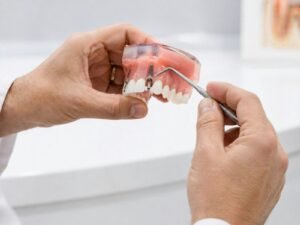
If you have spent years adjusting your life around missing teeth or removable dentures, you may already know that the problem is about much more than appearance. Eating can become harder. Dentures may move when you speak or chew. Certain foods may disappear from your diet. You may smile less often, avoid photographs, or simply become tired of thinking about your teeth every day.
Dental implants can support several types of replacement teeth, from a single crown to an implant-supported bridge, removable implant-retained dentures, or a fixed full-arch restoration. For many patients, the goal is simple: greater stability, better function, and less dependence on a removable denture.
This guide explains dental implants in clear language, including how they work, who may be a candidate, treatment options, recovery, risks, maintenance, and what international patients should consider when exploring dental implants in Costa Rica. SmileBridge Costa Rica helps patients from the United States and Canada understand their options, connect with selected dental implant clinics, and navigate the non-clinical parts of the journey with greater clarity and support.
What Is a Dental Implant?
A dental implant is a small post that is surgically placed in the jawbone to replace the root of a missing tooth. After the implant heals and integrates with the surrounding bone, it can support a dental restoration such as a crown, bridge, or denture.
According to the U.S. Food and Drug Administration, dental implants are medical devices placed in the jaw to help restore chewing ability and support artificial teeth. The FDA also notes that implants may help preserve surrounding bone and improve quality of life for appropriate patients. FDA: Dental Implants — What You Should Know.
The three basic parts of an implant restoration
- Implant: the portion placed into the jawbone, functioning much like an artificial tooth root.
- Abutment: a connector between the implant and the visible replacement tooth or prosthesis.
- Restoration: the crown, bridge, removable overdenture, or fixed full-arch prosthesis supported by the implants.
Cleveland Clinic describes these same three components and explains that implant treatment can replace one tooth, several teeth, or an entire upper or lower arch. Cleveland Clinic: Dental Implants.
Why Do Denture Wearers Start Looking for Dental Implants?
For many denture wearers, the search for implants does not begin because they want a “perfect smile.” It begins because they are tired of organizing daily life around their dentures.
Common frustrations can include:
- movement while eating or speaking;
- dependence on denture adhesive;
- sore spots or irritation;
- difficulty chewing certain foods;
- concern about the denture shifting in public;
- removing the prosthesis for cleaning or at night;
- feeling less confident smiling or speaking.
These experiences vary from person to person, but they are real. The CDC notes that tooth loss can contribute to difficulty eating, speaking, lower self-esteem, and reduced quality of life. CDC: About Tooth Loss.
For some people, traditional dentures work well. For others, an implant-supported option may provide greater stability. The appropriate choice depends on your oral condition, bone, general health, goals, and the clinical evaluation performed by a qualified dental team.
What Types of Dental Implant Solutions Exist?
“Dental implants” is not one single treatment. The implants are the foundation; the restoration placed on them can vary significantly.
Single-tooth dental implant
A single implant can support a crown when one tooth is missing. Unlike a traditional tooth-supported bridge, this approach usually does not require preparing the neighboring teeth simply to support the replacement tooth.
Implant-supported bridge
When several teeth are missing, two or more implants can support a bridge that replaces multiple teeth.
Implant-retained overdenture
An implant-retained or implant-supported removable denture connects to implants for added stability but can still be removed by the patient for cleaning. This can be an important middle ground for some denture wearers who want better retention but do not require or cannot receive a fixed full-arch restoration.
Fixed full-arch dental implants
A fixed full-arch restoration replaces all of the teeth in an upper or lower arch using several implants as support. The restoration is not removed by the patient at home. Specific approaches may include All-on-4, All-on-6, or other All-on-X configurations, depending on the treatment plan.
If you are exploring complete tooth replacement, see our guides to full-mouth dental implants in Costa Rica, All-on-4 dental implants, and All-on-6 dental implants.
What Is All-on-4?
All-on-4 is a full-arch treatment concept in which four implants are used to support a complete set of replacement teeth for one arch. It is one of several full-arch approaches, not automatically the best solution for every patient.
The number and position of implants depend on factors such as available bone, anatomy, bite forces, the planned prosthesis, medical history, and the clinical judgment of the treating team. Some patients may receive four implants; others may be better suited to six or more.
The American Academy of Implant Dentistry describes All-on-X as an approach for replacing a full upper or lower arch using implants placed in available bone, with temporary replacement teeth sometimes placed during the initial treatment phase when clinical conditions allow. AAID: Dental Implant Options.
Who May Be a Candidate for Dental Implants?
There is no reliable way to determine candidacy from a website alone. Your dental team needs to review your mouth, bone, medical history, medications, and imaging.
Factors commonly considered include:
- the amount and quality of available jawbone;
- gum and oral health;
- whether active infection or periodontal disease is present;
- smoking history;
- diabetes control and other medical conditions;
- medications that may affect surgery or healing;
- ability to maintain oral hygiene;
- the number of teeth that need replacement;
- your treatment goals and expectations.
The FDA specifically advises patients to discuss overall health, smoking, healing, risks, and whether they are candidates before treatment. Older age alone does not automatically determine candidacy; the clinical decision is individualized.
What if you have been wearing dentures for many years?
Long-term denture wear does not automatically mean implants are impossible. However, bone volume can change after tooth loss, so three-dimensional imaging may be needed to determine whether implants can be placed and whether bone grafting or another surgical approach should be considered.
If you have been told that you have bone loss, do not assume that every implant option is closed to you. A qualified implant team must evaluate your specific anatomy before drawing that conclusion.
How Does the Dental Implant Process Work?
The exact process varies, but treatment commonly includes several stages.
1. Consultation and diagnostic imaging
The team reviews your dental condition, medical history, medications, goals, and imaging. For complex or full-arch cases, cone-beam CT imaging is commonly used to evaluate the jawbone and anatomical structures.
2. Treatment planning
Your dentist or implant team determines how many implants may be needed, whether teeth must be removed, whether bone grafting is necessary, what type of temporary restoration may be used, and what final restoration is planned.
3. Implant surgery
The implants are placed into the jawbone. Depending on the case, extractions or grafting may occur at the same appointment or at another stage.
4. Healing and osseointegration
The jawbone gradually integrates with the implant surface. Cleveland Clinic notes that osseointegration can take several months, and the timeline varies with the individual and the treatment performed.
5. Final restoration
After the implants have healed sufficiently, the final crown, bridge, overdenture, or full-arch prosthesis is fitted and adjusted.
For international patients, this timeline is especially important because treatment may require more than one trip. SmileBridge helps patients understand the expected sequence, coordinate with selected clinics, and plan the non-clinical parts of the journey. You can see the broader process on our How It Works page.
Can Dental Implants Be Done in One Day?
Some patients may qualify for immediate placement or immediate loading protocols in which implants and temporary teeth are provided within a short time frame. However, “teeth in a day” does not mean the entire treatment is completed permanently in one appointment.
The implants still need to heal and integrate with the bone. A temporary prosthesis may be used while this happens, followed later by a definitive restoration. The AAID emphasizes that same-day full-arch treatment still involves planning, healing, checkups, and later delivery of the final teeth.
Whether immediate loading is appropriate depends on implant stability, bone, bite forces, medical considerations, and the treatment plan.
What Are the Potential Benefits of Dental Implants?
For appropriate patients, potential benefits can include:
- greater chewing stability;
- support for fixed or better-retained replacement teeth;
- improved speech and comfort in some patients;
- less concern about denture movement;
- support for jawbone preservation;
- improved confidence and oral-health-related quality of life;
- a long-term tooth-replacement option when properly maintained.
The goal should not be to promise that implants will make life perfect. The more realistic goal is to understand whether they can provide a more stable and functional solution for your specific situation.
What Are the Risks and Limitations?
Dental implant treatment is surgery and is not risk-free. The FDA lists possible complications including infection, damage to surrounding structures, sinus-related complications in some upper-jaw cases, nerve injury, problems with bite or function, and implant failure.
Other considerations include:
- treatment can require several months;
- bone grafting may be necessary;
- not every patient qualifies for immediate loading;
- temporary teeth may require dietary restrictions during healing;
- implant-supported teeth still require professional maintenance;
- smoking and uncontrolled medical conditions can negatively affect healing;
- prosthetic components can wear, loosen, fracture, or require repair over time.
A trustworthy treatment plan should explain benefits and limitations, not only the attractive parts of the procedure.
How Long Do Dental Implants Last?
Dental implants are designed as a long-term tooth-replacement solution, but no responsible provider can promise that an implant or prosthesis will last forever. Longevity depends on oral hygiene, professional maintenance, general health, smoking, bite forces, the type of restoration, and other individual factors.
The implant itself and the prosthetic teeth should also be thought of separately. An integrated implant may remain healthy while a crown, bridge, screw, attachment, or full-arch prosthesis eventually requires maintenance or replacement.
Do Dental Implants Require Maintenance?
Yes. Fixed does not mean maintenance-free.
Implant-supported teeth require daily cleaning and regular professional care. Your dental team may recommend specific brushes, flossing aids, water flossers, or other tools depending on the type of prosthesis.
If an implant becomes painful, feels loose, bleeds persistently, or the restoration changes in fit, it should be evaluated. The FDA specifically recommends regular dental visits and careful hygiene around implants.
Are Dental Implants an Option for Older Adults?
Many older adults consider implants after years of tooth loss or denture use. The CDC reports that complete tooth loss becomes increasingly common with age: 11.4% of U.S. adults ages 65–74 and 19.7% of adults age 75 and older had lost all permanent teeth in the most recent national surveillance data. CDC 2024 Oral Health Surveillance Report.
That does not mean every older adult needs implants. It does mean that many people reach retirement age living with substantial tooth loss and may not realize that modern implant-supported options exist.
The decision depends more on individual health, bone, medications, oral condition, and ability to heal and maintain the restoration than on age alone.
Why Do Some Patients Consider Dental Implants in Costa Rica?
Patients from the United States and Canada may begin researching Costa Rica after learning about full-mouth implant treatment locally and deciding they want to understand other options.
Cost is often part of that decision, but it should not be the only factor. Full-mouth implant treatment is complex. Patients should also consider:
- the training and experience of the clinical team;
- diagnostic and imaging protocols;
- implant and prosthetic materials;
- who performs the surgical and restorative phases;
- how complications and follow-up are handled;
- how many trips may be required;
- what temporary and final restorations are included;
- the maintenance plan after returning home.
SmileBridge Costa Rica is not a dental clinic and does not diagnose or prescribe treatment. Our role is to help international patients understand the journey, connect with selected dental implant clinics in Costa Rica, organize consultations, and navigate travel and logistics with a clear point of contact.
How SmileBridge Helps International Dental Implant Patients
Considering major dental treatment in another country can feel overwhelming, especially if you do not speak Spanish or have never traveled internationally for healthcare.
SmileBridge helps reduce that uncertainty by supporting the non-clinical side of the process. Depending on your needs, this can include:
- helping you understand the terminology and treatment journey;
- connecting you with selected dental implant clinics;
- organizing preliminary consultations and information exchange;
- helping coordinate appointments;
- guidance around accommodation and transportation;
- support for patients traveling alone or with a companion;
- a familiar point of contact before, during, and after your trip.
The clinical decisions remain with the licensed dental professionals evaluating and treating you. SmileBridge helps you navigate everything around those decisions so you do not have to figure out an unfamiliar international process alone.
What Should You Do Next?
If you are tired of living around missing teeth or dentures, the first step does not have to be surgery. It can simply be understanding what options may exist.
Learn about different treatment approaches. Ask questions. Gather your records. Understand what a proper clinical evaluation involves. And if you are considering Costa Rica, compare clinics based on more than price alone.
When you are ready, SmileBridge can help you take that next step. You can request a free initial consultation to discuss your situation, your questions, and how the process of exploring dental implant treatment in Costa Rica works.
Frequently Asked Questions About Dental Implants
Can I get dental implants if I have worn dentures for many years?
Possibly. Long-term denture wear does not automatically rule out implants. Your dental team will need to evaluate your bone, oral health, medical history, and imaging. Some patients may need bone grafting or a different implant approach.
Are dental implants fixed or removable?
They can support either. Implants may support fixed crowns, bridges, or full-arch restorations, and they can also stabilize removable implant-retained dentures. The appropriate design depends on your clinical needs and treatment goals.
Is All-on-4 the same as dental implants?
All-on-4 is one type of full-arch dental implant treatment. It uses four implants to support replacement teeth for one upper or lower arch. Dental implant treatment also includes single implants, implant bridges, overdentures, All-on-6, and other configurations.
Am I too old for dental implants?
Age alone does not determine candidacy. Overall health, oral health, medications, smoking, bone condition, healing capacity, and the planned treatment all matter. A qualified dental team must evaluate your individual situation.
Can I get dental implants if I have bone loss?
Bone loss can affect implant planning, but it does not automatically make treatment impossible. Depending on the location and severity, bone grafting or alternative implant strategies may be considered after clinical evaluation and imaging.
How long does dental implant treatment take?
The timeline varies widely. Implant healing and osseointegration often take several months, and complex full-arch cases may involve multiple stages and more than one trip for international patients.
Do dental implants require special care?
Yes. Implant-supported teeth need daily hygiene and regular professional maintenance. Fixed teeth are not maintenance-free, and the surrounding gums and bone must remain healthy.
How can SmileBridge help if I am considering dental implants in Costa Rica?
SmileBridge Costa Rica helps international patients understand the process, connect with selected dental implant clinics, organize consultations, and coordinate the non-clinical aspects of treatment travel. SmileBridge does not diagnose or prescribe dental treatment.
Related SmileBridge Guides
- All-on-4 Dental Implants: A Complete Patient Guide
- Full-Arch Dental Implants: A Complete Patient Guide
- Replacing Missing Teeth: A Complete Guide to Your Options
- Dental Implant Cost in Costa Rica: What Determines the Price?
Medical note: This article is for general educational purposes and does not replace diagnosis, examination, imaging, or treatment recommendations from a licensed dental professional.