If you are missing most or all of your teeth, wear a complete denture, or have been told that many of your remaining teeth cannot be saved, you may hear the term “full-arch dental implants.”
Full-arch treatment replaces an entire upper or lower set of teeth using multiple dental implants to support a new prosthesis. Depending on the treatment plan, the final teeth may be fixed in place or removable by the patient.
For many denture wearers, the interest in full-arch implants is not about having “perfect teeth.” It is about wanting teeth that feel more stable, make eating easier, reduce dependence on adhesive, and allow them to stop organizing daily life around a removable denture.
This guide explains the main full-arch options, how treatment works, who may be a candidate, risks and maintenance, and what international patients should understand when considering full-mouth or full-arch dental implant treatment in Costa Rica. SmileBridge Costa Rica helps U.S. and Canadian patients understand the journey and connect with selected clinics without replacing the role of the treating dental professionals.
What Does “Full-Arch” Mean?
An “arch” means one complete row of teeth — either the upper jaw or the lower jaw.
A full-arch implant restoration replaces all of the teeth in that arch and uses multiple implants as the foundation for the replacement teeth.
Cleveland Clinic describes full-arch implant treatment as the use of several implants — often four to six — to support a complete arch of replacement teeth. Depending on the design, the implants may support a fixed prosthesis or a removable denture that attaches to the implants. Cleveland Clinic: Dental Implants.
Is Full-Arch the Same as Full-Mouth Dental Implants?
Not exactly.
Full-arch usually means replacing all of the teeth in one jaw.
Full-mouth dental implants generally refers to replacing teeth in both the upper and lower arches.
For example:
- upper arch only = one full-arch restoration;
- lower arch only = one full-arch restoration;
- upper and lower arches = full-mouth rehabilitation.
If both arches need treatment, visit our page on full-mouth dental implants in Costa Rica.
What Are the Main Full-Arch Implant Options?
Fixed full-arch restoration
A fixed full-arch prosthesis is attached to the implants and is not removed by the patient for routine cleaning. A dental professional can remove it when necessary for maintenance or repair.
Implant-retained removable overdenture
An implant-retained overdenture uses implants to improve stability, but the patient removes the denture for cleaning.
This may be an important option for people who want greater stability than a traditional denture but are not candidates for — or do not choose — a fixed full-arch restoration.
All-on-4, All-on-6, and All-on-X
These terms describe different ways of supporting a full arch with dental implants.
All-on-4 typically uses four implants. All-on-6 typically uses six. “All-on-X” is a broader term that recognizes that the number of implants should be based on the individual treatment plan rather than a fixed marketing formula.
You can learn more in our All-on-4 patient guide and the existing SmileBridge page about All-on-6 dental implants in Costa Rica.
Why Do Denture Wearers Consider Full-Arch Implants?
Traditional dentures remain a valid treatment for many people. But some patients struggle with stability, comfort, chewing, speaking, or the daily routine of adhesives and removal.
The American Academy of Implant Dentistry notes that implant-retained dentures can offer greater stability than traditional dentures and may reduce problems such as movement and dependence on adhesive. AAID: When to Consider Implant-Retained Dentures.
For patients who qualify for fixed treatment, the appeal may be even more specific:
- replacement teeth that stay in place;
- greater confidence while eating and speaking;
- less worry about a denture shifting;
- a more stable foundation for chewing;
- a treatment designed for long-term use.
That does not mean full-arch implants are automatically better for everyone. Surgery, cost, maintenance, healing time, medical conditions, and bone availability all matter.
Who May Be a Candidate for Full-Arch Dental Implants?
Full-arch treatment is typically considered when a patient has:
- lost all teeth in an arch;
- many teeth that cannot be predictably restored;
- a complete denture and wants to explore implant-supported alternatives;
- severe tooth damage or advanced periodontal problems affecting most of an arch.
Clinical candidacy depends on more than the number of missing teeth.
The treating team may evaluate:
- jawbone quantity and quality;
- gum health;
- infection and periodontal disease;
- medical conditions such as diabetes;
- medications;
- smoking;
- healing capacity;
- bite forces and grinding;
- manual ability and willingness to maintain the restoration;
- realistic expectations.
The FDA advises patients to discuss overall health, smoking, risks, and healing with the dental provider before implant treatment. FDA: Dental Implants — What You Should Know.
What Happens If You Have Significant Bone Loss?
Bone changes are common after teeth have been missing for many years.
Some full-arch concepts are designed to make efficient use of remaining bone, but that does not mean every patient can avoid grafting. Depending on the upper or lower jaw, bone volume, sinus anatomy, and treatment goals, the clinic may consider:
- bone grafting;
- sinus augmentation;
- different implant lengths or positions;
- a removable implant-supported solution;
- other advanced implant approaches.
No website can determine which approach is appropriate from symptoms alone. Three-dimensional imaging and a clinical examination are essential.
How Does Full-Arch Treatment Usually Work?
Stage 1: Records, examination, and imaging
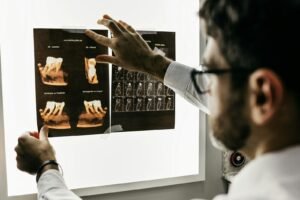
The clinic reviews your dental and medical history, current medications, teeth, gums, bite, and jawbone. CT imaging is often important for complex implant planning.
Stage 2: Treatment design
The team determines:
- which teeth, if any, need removal;
- how many implants are planned;
- whether grafting is necessary;
- the type of temporary prosthesis;
- the material and design of the final prosthesis;
- the expected number of appointments and treatment stages.
Stage 3: Surgery
Extractions, implant placement, and other procedures are performed according to the individual plan.
Stage 4: Temporary teeth
Some patients may qualify for a temporary fixed prosthesis soon after surgery. Others may need a different temporary solution while healing.
Stage 5: Healing
The implants need time to integrate with the jawbone. This biological process is called osseointegration and can take several months.
Stage 6: Final teeth
After the implants have healed sufficiently, the definitive prosthesis is fitted, adjusted, and attached.
What Is the Difference Between Temporary and Final Full-Arch Teeth?
This is one of the most important questions for international patients.
A temporary prosthesis is designed to function during the healing period. It may look very good and allow the patient to avoid being without teeth, but it is not necessarily the same restoration that will be worn long term.
The final prosthesis is generally designed after healing, when the clinic can evaluate implant integration, tissue changes, bite, aesthetics, and final fit.
When comparing quotes, ask:
- Is a temporary prosthesis included?
- What material is it made from?
- Is the final prosthesis included?
- What material is planned for the final teeth?
- How many visits are included for fitting and adjustment?
Are Full-Arch Teeth Really “Permanent”?
Patients often use the word “permanent” to mean fixed — something they do not remove at night.
That is understandable, but clinically it is better to think of full-arch implant treatment as a fixed, long-term restoration.
The implants may function for many years when healthy and properly maintained, but prosthetic teeth, screws, connectors, or other components can eventually need adjustment, repair, or replacement.
No responsible clinic should promise that a full-arch restoration will never require maintenance.
How Do You Clean Full-Arch Dental Implants?
Fixed full-arch teeth still need daily hygiene.
Cleaning usually focuses on removing plaque and food around the implants and under the prosthesis. Depending on the restoration, the dental team may recommend:
- special floss or threaders;
- interdental brushes;
- water flossing devices;
- specific brushing techniques;
- professional maintenance at regular intervals.
Maintenance is not optional. Healthy gums and bone around the implants are essential for long-term success.
What Are the Risks of Full-Arch Dental Implants?
Because full-arch treatment involves surgery and a complex prosthesis, patients should understand both surgical and restorative risks.
Possible complications include:
- infection;
- failure of one or more implants to integrate;
- bone or gum inflammation around implants;
- nerve or sinus-related injury depending on implant location;
- prosthetic fracture or wear;
- screw loosening;
- difficulty cleaning under the prosthesis;
- bite-related complications;
- need for future repair or replacement of prosthetic components.
The right question is not whether a clinic claims complications “never happen.” The better question is how the clinic plans, prevents, monitors, and manages them.
How Should You Compare Full-Arch Treatment Proposals?
Two quotes can look similar while including very different things.
Compare:
- number and brand of implants;
- who performs surgery;
- who designs the prosthesis;
- temporary restoration;
- final restoration;
- prosthetic materials;
- extractions;
- bone grafting;
- sedation or anesthesia;
- imaging;
- number of visits;
- follow-up care;
- maintenance expectations;
- what happens if an implant fails to integrate.
A lower price is not meaningful unless you know what is and is not included.
Why Do International Patients Explore Full-Arch Implants in Costa Rica?
Full-arch and full-mouth implant treatment can represent a major financial commitment in the United States or Canada. Some patients begin researching Costa Rica after receiving local estimates they consider difficult to justify, especially during retirement.
But the goal should not be to find the cheapest clinic.
The goal should be to understand whether a selected clinic in Costa Rica can offer an appropriate treatment plan, experienced clinical team, clear materials and procedures, realistic follow-up, and a cost structure that makes sense for the patient.
SmileBridge helps international patients explore that process without having to evaluate unfamiliar clinics alone.
How SmileBridge Supports the Full-Arch Dental Journey
SmileBridge Costa Rica is an international dental patient advisory service. We do not diagnose, prescribe, or perform dental treatment.
Our role is to help patients navigate the parts surrounding treatment, including:
- understanding treatment terminology;
- connecting with selected dental implant clinics;
- organizing preliminary consultations;
- helping patients prepare questions and compare information;
- coordinating appointments;
- guidance around travel, hotels, and transportation;
- support for companions and solo travelers;
- remaining a familiar point of contact through the journey.
You can see the broader process at How It Works or request a free initial consultation if you want to understand whether exploring full-arch treatment in Costa Rica makes sense for you.
Frequently Asked Questions About Full-Arch Dental Implants
How many implants are needed for a full arch?
There is no single number for every patient. Many full-arch restorations use four to six implants, but the final number depends on bone, anatomy, bite, prosthetic design, and the clinical plan.
Are full-arch dental implants fixed?
They can be. Fixed full-arch restorations are not removed by the patient. Implant-retained overdentures are also supported by implants but remain removable.
Is full-arch the same as All-on-4?
All-on-4 is one type of full-arch implant treatment. Full-arch is the broader category and can include All-on-4, All-on-6, other All-on-X designs, and removable implant-supported options.
Can I get full-arch implants after years of wearing dentures?
Possibly. Long-term tooth loss can lead to bone changes, so imaging is essential. Some patients may need grafting or a different implant strategy, but denture history alone does not determine candidacy.
How long does full-arch treatment take?
The overall process usually spans several months because implants need time to heal and integrate with the jawbone. The exact sequence depends on extractions, grafting, temporary teeth, healing, and the final restoration.
Can I get temporary fixed teeth right away?
Some patients qualify for immediate loading, but not everyone does. Implant stability, bone, bite forces, health, and the clinical plan determine whether temporary fixed teeth can be used soon after surgery.
Do full-arch implants need maintenance?
Yes. Fixed full-arch teeth need daily cleaning and professional maintenance. The prosthesis and implant components may also require repair or replacement over time.
How can SmileBridge help with full-arch dental implants in Costa Rica?
SmileBridge helps international patients understand the process, connect with selected dental implant clinics in Costa Rica, organize consultations, and coordinate travel and logistics. Clinical decisions remain with the treating dental professionals.
Related SmileBridge Guides
- All-on-4 Dental Implants: A Complete Patient Guide
- Complete Guide to Dental Implants
- Replacing Missing Teeth: A Complete Guide to Your Options
- Dental Implant Cost in Costa Rica
Medical note: This article is intended for general education and does not replace examination, imaging, diagnosis, or treatment recommendations from a licensed dental professional.